
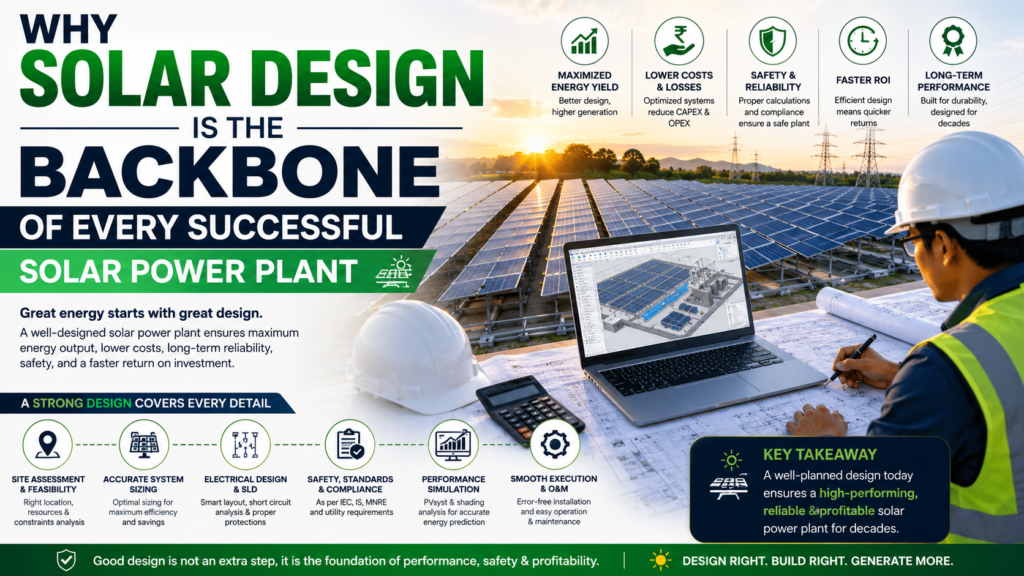
The global solar industry is expanding rapidly as businesses and homeowners increasingly adopt renewable energy. However, installing high-quality solar panels alone does not guarantee a successful project. Behind every efficient, safe, and profitable solar power plant lies one essential element—solar design.
A well-designed solar system maximizes energy production, minimizes losses, ensures electrical safety, and delivers the expected return on investment (ROI). Whether you’re planning a residential rooftop system, a commercial installation, or a utility-scale solar power plant, proper engineering design is the foundation of long-term success.
In this article, we’ll explore why solar design is considered the backbone of every successful solar power plant and how it directly impacts performance, reliability, and profitability.
What Is Solar Design?
Solar design is the engineering process of planning and optimizing a solar photovoltaic (PV) system before installation. It involves technical calculations, equipment selection, electrical design, structural analysis, and compliance with applicable standards.
A complete solar design typically includes:
- Site survey and feasibility study
- Solar resource assessment
- Shadow analysis
- Module layout planning
- Inverter sizing and selection
- DC and AC cable sizing
- String configuration
- Single Line Diagram (SLD)
- Earthing and lightning protection design
- Structural design
- Energy generation estimation
- Bill of Materials (BOM)
Without these steps, even premium solar components may fail to deliver optimal performance.
Why Solar Design Matters
- Maximizes Energy Generation
The primary objective of any solar project is to generate maximum electricity.
Proper solar design optimizes:
- Panel orientation
- Tilt angle
- Module spacing
- String configuration
- Inverter loading
- System voltage
Even small design improvements can significantly increase annual energy production over the plant’s 25-year lifespan.
- Reduces Power Losses
Every solar power plant experiences electrical losses.
A professional solar designer minimizes:
- DC cable losses
- AC cable losses
- Mismatch losses
- Shading losses
- Temperature losses
- Soiling losses
- Inverter losses
Reducing these losses directly increases plant efficiency and revenue.
- Ensures Electrical Safety
Solar power plants operate with high DC voltages that require careful engineering.
A proper solar design includes:
- Correct cable sizing
- Proper circuit protection
- Earthing system
- Lightning protection
- Short-circuit calculations
- Voltage drop calculations
- Protection coordination
These measures reduce the risk of fire, equipment damage, and electrical hazards.
Improves Return on Investment (ROI)
Every investor wants the highest possible return.
A well-designed solar plant offers:
- Higher annual generation
- Lower maintenance costs
- Longer equipment life
- Reduced downtime
- Better financial performance
Poor design often results in lower production, expensive repairs, and delayed payback periods.
Prevents Common Installation Mistakes
Many solar installations underperform because of poor planning.
Common design errors include:
- Incorrect inverter sizing
- Improper string design
- Excessive cable losses
- Shadow from nearby structures
- Wrong module orientation
- Poor ventilation around equipment
- Undersized transformers
- Improper protection devices
Professional solar design eliminates these issues before installation begins.
Supports Future Expansion
Businesses often expand their electricity demand over time.
A scalable solar design considers:
- Additional rooftop space
- Future inverter capacity
- Extra electrical panels
- Battery integration
- EV charging infrastructure
Planning for expansion reduces future modification costs.
Optimizes Equipment Selection
Every project requires selecting components that work efficiently together.
Solar design helps choose the right:
- Solar modules
- Inverters
- Transformers
- ACDB/DCDB panels
- Cables
- Earthing materials
- Mounting structures
- Monitoring systems
Proper equipment matching improves overall plant reliability.
Ensures Compliance with Standards
Every solar installation must comply with national and international standards.
Professional solar design follows guidelines such as:
- IEC standards
- IS standards
- National Electrical Code (where applicable)
- Utility interconnection requirements
- Local electrical regulations
Compliance simplifies approvals and improves project safety.
Improves Maintenance and Troubleshooting
A properly documented solar design includes:
- Single Line Diagram (SLD)
- Cable schedules
- String layout
- Equipment layout
- Earthing layout
- Protection diagrams
These documents help maintenance teams quickly identify and resolve faults, reducing downtime.
Role of a Solar Design Engineer
A Solar Design Engineer is responsible for transforming project requirements into a technically sound and efficient system.
Typical responsibilities include:
- Site analysis
- PV system sizing
- AutoCAD layouts
- PV simulation
- Shadow analysis
- Electrical calculations
- SLD preparation
- BOM preparation
- Yield estimation
- Grid compliance
Their expertise ensures that the installed system performs as expected throughout its lifetime.
Tools Used in Solar Design
Modern solar engineers use specialized software to improve design accuracy.
Popular tools include:
- AutoCAD
- PVsyst
- Helioscope
- SketchUp
- Google Earth Pro
- Excel
- ETAP
- OpenSolar
These tools help optimize layouts, estimate energy production, and reduce engineering errors.
Real-World Impact of Good Solar Design
Imagine two identical 500 kW solar power plants installed in the same location.
Plant A has a professionally engineered design.
Plant B uses poor module spacing, oversized cable runs, incorrect string configuration, and inadequate shading analysis.
After one year:
- Plant A generates more electricity.
- Plant A experiences fewer faults.
- Plant A requires less maintenance.
- Plant A delivers a faster payback period.
- Plant A achieves a higher return on investment.
The difference isn’t the solar panels—it’s the quality of the solar design.
Best Practices for Effective Solar Design
To achieve optimal performance:
Conduct a detailed site survey.
Perform accurate shadow analysis.
Optimize tilt angle and orientation.
Minimize cable lengths.
Size inverters correctly.
Maintain acceptable voltage drop limits.
Use quality components.
Follow applicable electrical standards.
Validate energy generation using simulation software.
Prepare complete engineering documentation before installation.
Conclusion
Solar panels generate electricity, but solar design determines how efficiently they perform.
A professionally engineered solar power plant delivers higher energy generation, improved safety, lower maintenance costs, and better financial returns over its lifetime. From system sizing and equipment selection to electrical protection and future scalability, every aspect of a successful solar project begins with thoughtful design.
Whether you’re a homeowner, business owner, EPC contractor, or aspiring Solar Design Engineer, investing time and resources in proper solar design is one of the smartest decisions you can make. In the world of renewable energy, great design isn’t just an advantage—it’s the backbone of every successful solar power plant.